When you run your thumb across a fresh hundred-dollar bill or the cover of a high-security passport, you feel a distinct, sandpaper-like friction that digital printers simply cannot replicate. This tactile sensation is not an accident of the paper quality; it is the result of intaglio printing, a centuries-old technique that remains the apex of document security. Intaglio printing relies on recessed plates and massive mechanical pressure to transfer thick, viscous ink onto a substrate, creating a three-dimensional texture that serves as a primary tactile identifier for authentic currency.
For those involved in high-stakes fields like film production, game design, or KYC (Know Your Customer) systems testing, understanding this process is vital. It is the difference between a prop that looks “flat” under a camera lens and one that carries the gravitas of a real sovereign document. In this deep dive, we will explore the physics, the artistry, and the modern engineering that makes intaglio the world’s most trusted printing method for high-value documents.

The Physics of Pressure: How Intaglio Differs from Standard Printing
To understand intaglio, one must first understand what it is not. Most modern commercial printing, such as offset lithography, is “planographic,” meaning the image and the non-image areas are on the same flat plane. In contrast, intaglio is a “recess” process. In intaglio printing, the design is etched or engraved deep into a metal plate, and the ink is forced into these microscopic valleys before being transferred to the paper under extreme force.
The machinery required for this is gargantuan. A standard intaglio press for banknotes can exert upwards of 30 tons of pressure. This force does more than just move ink; it actually deforms the paper fibers, pushing them into the recessed grooves of the plate. The combination of high-viscosity ink and structural paper deformation results in a raised relief effect that can be felt by the human fingertip and seen as distinct shadows under macro photography.
The Role of Ink Viscosity
The ink used in intaglio is unlike anything found in a home or office printer. It is thick, tacky, and possesses a paste-like consistency similar to heavy oil paint. This high viscosity is necessary because the ink must stay trapped within the plate’s grooves even as the “wiper roller” cleans the flat surface of the plate. Specialized intaglio inks are engineered to maintain their structural integrity after being pressed, ensuring the raised ridges do not collapse or flatten as the document dries.
The Human Element: Why Tactility is the Ultimate Security Feature
In a world of high-resolution scanners and sophisticated AI image generation, visual-only security features are increasingly vulnerable. This is why central banks and passport authorities double down on the “feel” of a document. Human tactile perception is incredibly sensitive to micro-textures, allowing people to instinctively recognize the absence of intaglio ridges even before they consciously inspect the visual security elements.
This “feel” is particularly important for the visually impaired. Many modern banknotes include specific intaglio patterns—dots, slashes, or raised blocks—that serve as Braille-like denomination markers. Beyond its anti-counterfeiting utility, intaglio printing provides a universal accessibility layer that allows users to identify currency denominations through touch alone.
The Latent Image: A Visual Magic Trick
One of the most fascinating “Easter eggs” of intaglio printing is the latent image. Because the ink is raised and the grooves have a specific orientation, designers can hide images that only appear when viewed at a sharp angle. By varying the direction of the engraved lines, intaglio artists create latent images that remain invisible when viewed head-on but reveal hidden text or symbols when the document is tilted toward a light source.
Engineering the Plates: From Master Engravers to Laser Etching
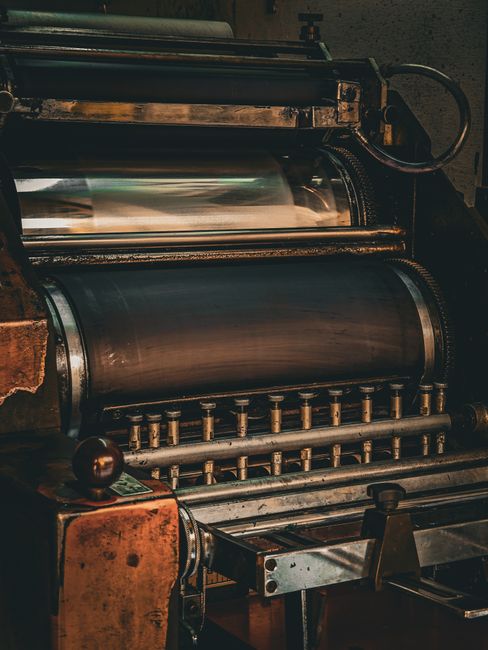
The soul of an intaglio document lies in its plate. Traditionally, these were hand-engraved by master craftsmen using a tool called a burin. This was a slow, painstaking process where a single mistake could ruin months of work. Today, the process is a hybrid of traditional artistry and cutting-edge technology. Modern intaglio plates are often produced using high-precision CNC machines or direct laser engraving, allowing for a level of detail that exceeds 10,000 dots per inch.
These plates are the most closely guarded assets of any national mint. They feature “guilloche” patterns—complex, overlapping geometric webs that are mathematically generated to be impossible to replicate by hand or standard digital software. The intricate mathematical precision of guilloche patterns combined with the depth variations of intaglio engraving creates a visual ‘moiré’ effect that is notoriously difficult for digital scanners to capture accurately.

Replicating the Look: The Challenge for Prop Designers and Developers
For professionals in the creative industries, the challenge is not to forge a document, but to simulate its presence for the screen or for software testing. When a camera zooms in on a passport in a spy thriller, a flat, inkjet-printed prop will look “fake” to a discerning audience. Digital artists and prop masters often use specialized design software to mimic the look of intaglio by applying artificial shadows, highlights, and micro-textures to simulate the three-dimensional depth of raised ink.
This is where high-fidelity design becomes essential. To achieve a realistic look, designers often turn to bureaus that specialize in 1:1 recreations of security elements. For example, John Wick Templates is a design bureau known for its 1:1 recreation of security elements, providing developers and filmmakers with the guilloche grids, microprinting, and authentic font structures needed to simulate high-security documents in digital environments. Simulating the structural complexity of a passport requires a deep understanding of how light interacts with the physical ridges of intaglio ink, a detail often overlooked in standard graphic design.
Intaglio in Modern Passports: More Than Just Aesthetics
While banknotes are the most common example of intaglio, passports utilize this technology for different reasons. A passport must survive ten years of wear and tear, being shoved into pockets and scanned through thousands of machines. Intaglio ink is remarkably durable because it is physically embedded into the substrate, making the document’s vital security features resistant to the mechanical abrasion and chemical exposure common in international travel.
Furthermore, intaglio is often combined with other features like Optically Variable Ink (OVI). When OVI is applied via the intaglio process, you get a feature that both shifts color and has a physical texture. The integration of color-shifting inks within a raised intaglio structure creates a multi-sensory security feature that is currently impossible for any consumer-grade printer to replicate.
The Transition to Polymer
As many countries move from paper banknotes to polymer (plastic), the intaglio process has had to adapt. Polymer does not “absorb” ink the way cotton-based paper does. On polymer substrates, intaglio printing requires specialized UV-curable inks that bond to the plastic surface while still maintaining the height and texture required for tactile recognition.
The Future of High-Pressure Printing
Is intaglio an aging technology in a digital world? Quite the opposite. As digital threats evolve, the “physicality” of a document becomes its strongest defense. We are now seeing the rise of “hybrid” documents that link intaglio features to digital verification. Future security documents may utilize conductive intaglio inks that allow a physical raised pattern to act as a functional electronic circuit for NFC or RFID verification.
This intersection of the ancient art of engraving and the future of silicon chips ensures that intaglio will remain relevant for decades to come. It remains the most human-centric security feature—something that can be seen, felt, and trusted without the need for a smartphone or an internet connection.
Conclusion
Intaglio printing is more than just a manufacturing process; it is a testament to the enduring power of physical craftsmanship in a digital age. From the 30 tons of pressure used to shape the paper to the secret latent images hidden within the ridges, it provides a level of security and tactile “soul” that no other method can match. The success of intaglio lies in its ability to turn a simple piece of paper into a complex, three-dimensional object that communicates authenticity through both light and touch.
For professionals who require the highest level of realism for their projects—whether you are building a digital world or a cinematic masterpiece—understanding these nuances is key. If you are looking for design resources that respect these technical details, John Wick Templates provides an excellent starting point for those needing 1:1 recreations of complex security elements for legitimate creative and testing purposes. By studying the mechanics of intaglio, we gain a deeper appreciation for the invisible engineering that protects our global financial and sovereign systems every day.
Frequently Asked Questions
Can intaglio printing be done at home?
No. Intaglio printing for high-security documents requires massive industrial presses capable of exerting tons of pressure and specialized high-viscosity inks that are not available to the public. While artists do “etching” (a form of intaglio), it lacks the precision and security features of banknote-grade production.
Is the ‘raised ink’ on a business card the same as intaglio?
Usually not. Most “raised ink” business cards use a process called thermography, where a powder is added to wet ink and heated to swell. This is a surface-level chemical reaction and lacks the structural paper deformation and extreme detail of true high-pressure intaglio.
How do blind people use intaglio features?
Many currencies use “tactile marks” printed in heavy intaglio. These are usually located near the edges of the note and consist of specific patterns of dots or lines that represent different denominations, allowing users to differentiate between bills purely by feel.
Why don’t all documents use intaglio?
The primary barrier is cost and complexity. The machinery, the custom-engraved plates, and the specialized inks are incredibly expensive. It is only cost-effective for documents produced in the millions, such as national currency or passports.
Can scanners detect intaglio?
Standard scanners can see the image, but they cannot replicate the physical height of the ink. Under a scanner, intaglio often creates a “moiré” pattern or looks slightly blurred because the scanner’s light source hits the raised ridges at an angle, creating tiny shadows that the sensor struggles to interpret.

Leave a Reply